

Introduction
Imagine this.
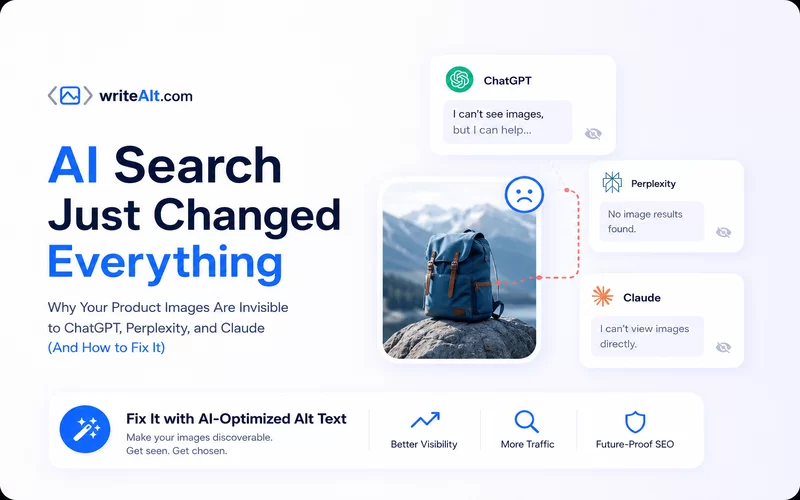
A customer opens ChatGPT and types: "What are the best waterproof hiking boots under $150?"
ChatGPT scans the web. It reads blog posts, reviews, product pages, and specifications.
But it cannot see your product photos.
None of them.
Your brown leather boots with the lug sole? Invisible. Your mountain trail lifestyle shot? Invisible. Your detailed product gallery showing the reinforced stitching and weatherproof membrane? Completely invisible to AI.
Here's what ChatGPT sees when it looks at your image without alt text:
<img src="product-12345.jpg" alt="">
Nothing. Zero. Zilch.
And here's what happens to that customer: they get recommendations from your competitors who actually bothered to add alt text.
This isn't a hypothetical problem. It's happening right now, millions of times per day.
The Shift Nobody Is Talking About
For twenty years, SEO meant optimizing for Google.
You chased backlinks. You stuffed keywords. You prayed for page one.
But the internet has changed.
In 2024 and 2025, generative AI search exploded. ChatGPT has over 400 million weekly active users. Perplexity is growing faster than Google did in its early years. Microsoft Copilot, Claude, Gemini — every major AI now includes web search with answers sourced from real websites.
And every single one of these AI tools reads alt text.
They have to. AI cannot actually "see" images the way humans do. They read the HTML. And if your alt attribute is empty, the AI sees nothing.
This creates a massive opportunity for businesses that understand what's happening — and a massive risk for those that don't.
The Technical Reality: How AI Reads Your Images
Here's what actually happens when an AI like ChatGPT crawls your e-commerce product page:
Step 1: The AI downloads your HTML
Step 2: It reads every text element — headlines, descriptions, prices, reviews
Step 3: It encounters your image tag: <img src="product.jpg" alt="...">
Step 4: It reads the alt attribute as the description of that image
Step 5: If alt is empty, the AI assigns no meaning to that image
The AI doesn't know your product is red. It doesn't know it's leather. It doesn't know it's waterproof.
Because you never told it.
The image filename doesn't count. IMG_58492.jpg tells the AI exactly nothing.
Alt Text Is Not Just for Accessibility Anymore
For years, we've known that alt text helps two groups:
Visually impaired users using screen readers
Google Image Search for ranking in image results
Both of these are still true. But AI search has created a third, much larger reason to care about alt text.
Alt text is now the bridge between your visual products and AI-powered discovery.
Think of alt text as the translation layer. Your image is a beautiful visual. AI speaks text. Alt text translates your visual into text the AI can understand, index, and recommend.
No translation? No recommendation. Simple as that.
Real Examples: With Alt Text vs Without
Let me show you exactly what I mean.
Scenario A: No alt text
Your product page has a stunning image of hiking boots. The alt attribute is empty.
When AI looks at your page, here's what it records:
| Element | What AI sees |
|---|---|
| Product title | Men's Waterproof Hiking Boots |
| Price | $149.99 |
| Description | Leather upper, rubber lug sole... |
| Image | (nothing — empty alt tag) |
Result: The AI has incomplete information. It knows you sell hiking boots, but it doesn't know what they look like, what color they are, or how they're styled. Your product is less likely to be recommended.
Scenario B: With alt text
Same image, but now with:
alt="Men's waterproof hiking boots, brown leather, black rubber lug sole, shown on rocky mountain trail with snow in background"
Now the AI records:
| Element | What AI sees |
|---|---|
| Product title | Men's Waterproof Hiking Boots |
| Price | $149.99 |
| Description | Leather upper, rubber lug sole... |
| Image | Men's waterproof hiking boots, brown leather, black rubber lug sole, shown on rocky mountain trail |
Result: Complete product data. The AI understands color (brown), material (leather), sole type (lug), use case (waterproof, mountain), and setting (snow). Your product is now eligible for AI recommendations for queries like "brown leather hiking boots" or "winter hiking boots for snow."
This is not theory. This is how the technology works today.
The SEO Benefit Nobody Expected
Here's what surprises most business owners.
When AI tools like Perplexity or ChatGPT cite your product in an answer, they link back to you.
Those links send real traffic.
Real customers.
Real sales.
And the best part? This traffic is often higher quality than organic Google traffic because the AI has already qualified the lead. The customer asked a specific question, the AI found your product as the answer, and the customer arrives already interested.
One WriteAlt user, an e-commerce store owner with 3,600 product images, saw a measurable increase in image search visibility within weeks of implementing alt text across their catalog. Not because Google changed anything — but because AI search started finding their products.
What Good Alt Text Actually Looks Like
Most people get alt text wrong. Here's what works for AI search:
Bad alt text (too vague):
alt="hiking boots"
Bad alt text (keyword stuffing):
alt="buy hiking boots best hiking boots cheap hiking boots men's hiking boots"
Good alt text (descriptive, natural, useful):
`alt="Men's waterproof hiking boots, brown full-grain leather, black rubber lug sole, ankle height, shown on mountain trail with snow"
The formula:
[Product type] + [material] + [color] + [key features] + [context/setting]
Apply this to every product image in your catalog and watch your AI visibility transform.
The Problem: Doing This Manually Is Impossible
Here's the reality check.
If you run an e-commerce store with 500 products, each with 3-5 images, you have 1,500 to 2,500 images that need alt text.
Writing high-quality, descriptive alt text for each one takes:
30 seconds per image (minimum)
1,500 images = 12.5 hours
5,000 images = 40+ hours
Nobody has that kind of time.
And if you manage multiple stores? Or a marketplace with thousands of listings? Manual alt text is simply not feasible.
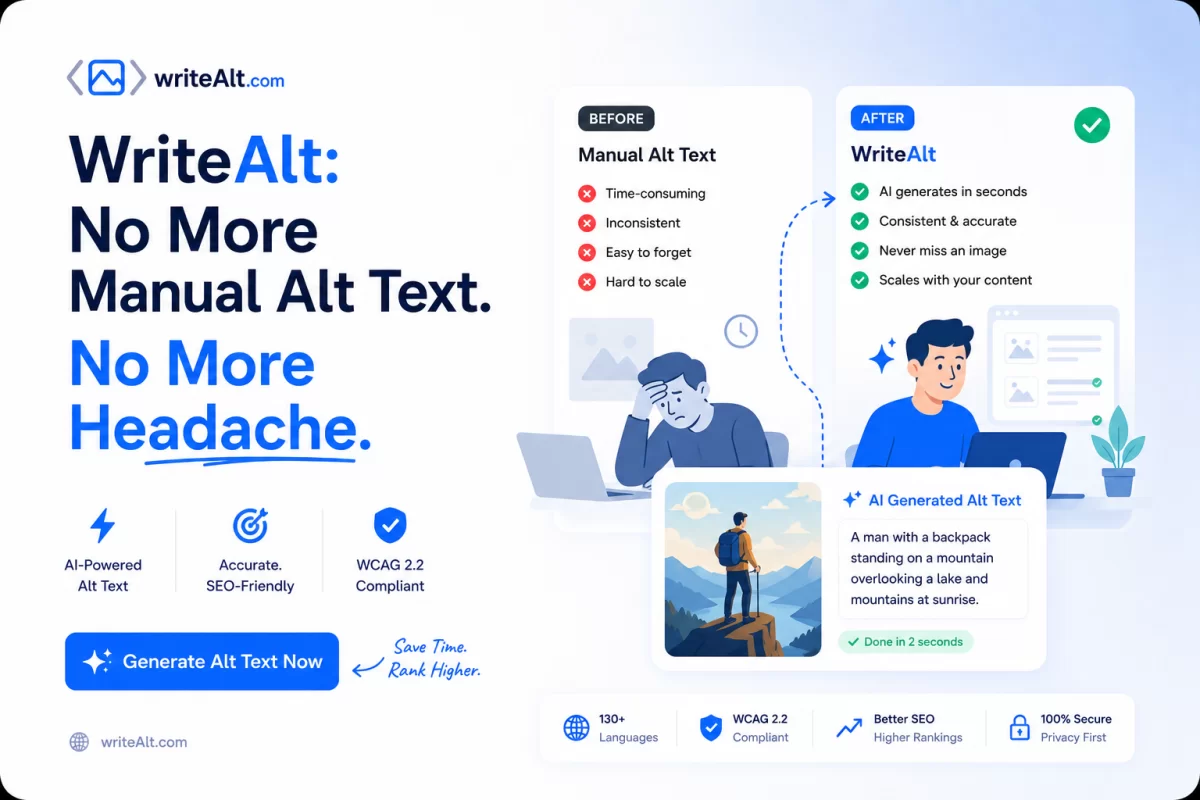
This is why AI-generated alt text has become essential. Not to replace human judgment — but to scale what works.
What to Do Right Now
If you want your products to be visible in AI search results, here's your action plan:
Step 1: Audit your current alt text
Check your product images. Are the alt tags empty? Are they just filenames? Are they generic like "product image"?
Step 2: Prioritize your best-selling products
Start with your top 20% of products that generate 80% of your revenue. Get those alt texts right first.
Step 3: Write descriptive, useful alt text
Use the formula above. Include product type, material, color, features, and context.
Step 4: Scale to your entire catalog
Once you have a system that works, apply it to all your images.
Step 5: Monitor your AI search traffic
Watch your analytics for referral traffic from AI search platforms. You'll start seeing it within weeks.
The Bottom Line
AI search isn't coming. It's already here.
Millions of people start their shopping journey with ChatGPT, Claude, and Perplexity every single day. They're asking questions. They're getting answers. And they're clicking links.
If your products don't have alt text, you are invisible to these tools. Full stop.
Not "less visible." Not "disadvantaged."
Invisible.
But here's the good news: fixing this is simple. Alt text takes seconds to generate with the right tool. And once it's done, your products become discoverable across every AI platform simultaneously.
The question isn't whether you should add alt text.
The question is: can you afford not to?
Ready to make your products visible to AI search?
WriteAlt generates SEO-optimized alt text for your images in seconds — in over 130 languages. Your first 25 images are free. No credit card required.